April 22, 2014

The April Garden - Mason Bees and Emerging Plants

Just a few quick shots of the garden taken yesterday. I'm happy to report lots of Mason Bee activity! You can see a female adding mud to finish off another tube. There are more completed tubes than I expected this first year. I think more bees than the ones I purchased found the home. Yea!

I am doing lots of weeding (hoeing and pulling) of all the little weeds that enjoy the current conditions of moisture and light.


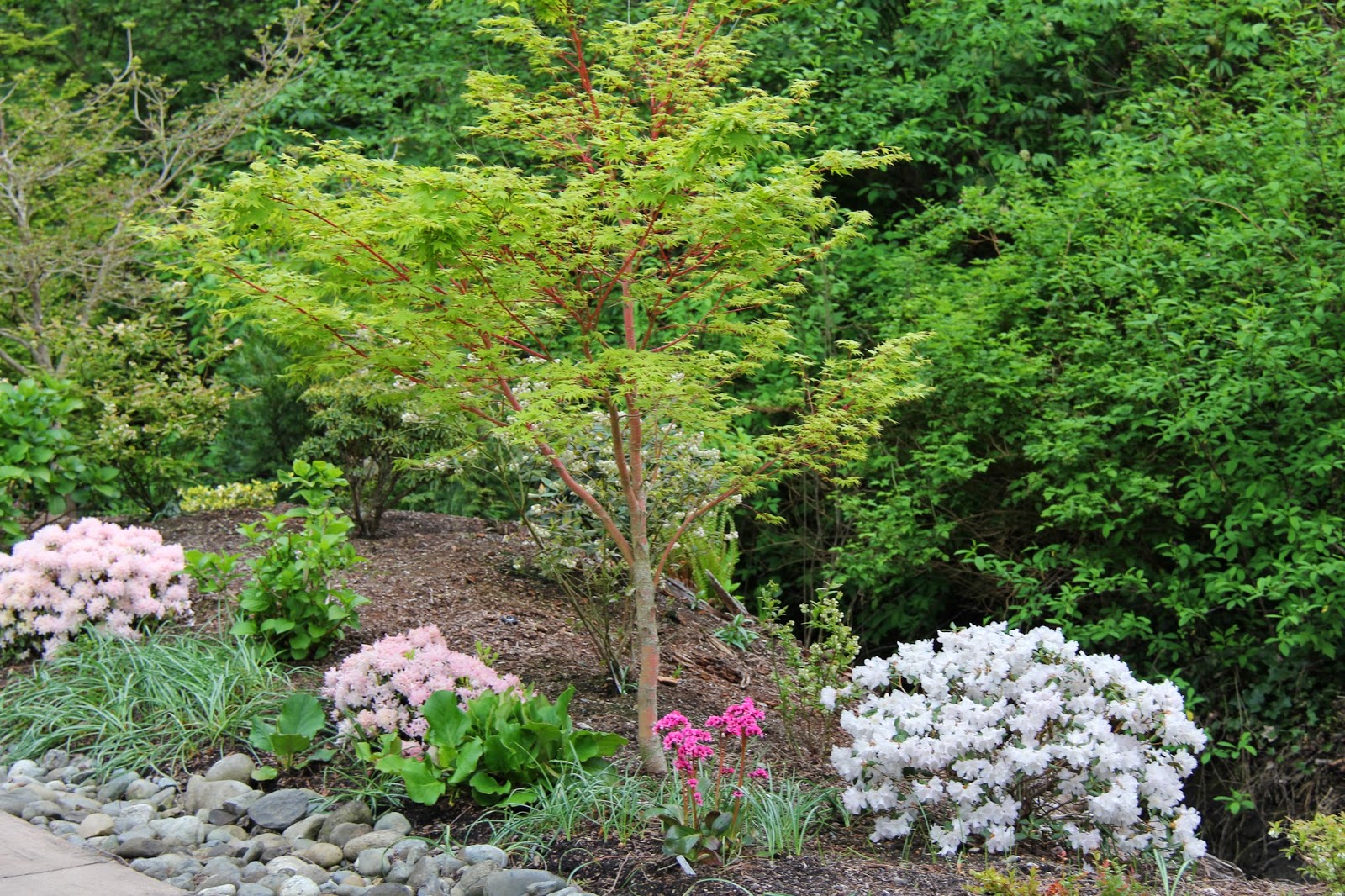
Rock garden area near upper driveway.
 

These little iris came from my sister and are doing wonderfully in a few places near the upper driveway.

These fronds are from the royal fern, and it is majestic when open.

Some small-sized rhodies and blueberries enjoy an area with very well-draining soil, as it is over an old rotten cedar tree.

April 7, 2014

Marine Hills Garden Club Plant Sale

A lot of my garden plants came from my garden club plant sales. Great prices for good quality ornamental and native plants. Our next plant sale is:

Saturday, April 26 from 10 am to 3 pm
 
Plant Sale in Federal Way
 
Marine Hills Garden Club has a great assortment of annuals, perennials and native plants for sale.
Come early for best selections.
 
Location: 29301  7th Place South in Federal Way
 
Questions? Call 253-839-4413 or e-mail judymcdonald41@yahoo.com

March 24, 2014

Top dressing my flower beds with compost

I purchased 22 bags of compost and spread over my flower beds yesterday and today. I also spread it where I will be planting scarlet runner beans and cucumbers. While more expensive to work from bags, we find it much easier and the compost has "cured" a little longer, making it a better quality than bulk compost.
The compost add some nutrients, and I had spread some fertilizer over much of these beds last week.


I added a little bark to freshen up my little Japanese garden:

Mason bees are out (Blue Orchard Bees)

After hibernating for several months in my refrigerator, I set out my new mason bees. They've been very active for the past week. I'm lucky to have a little stream along the side of my property, so the females can get mud for placing in the tubes to separate their eggs. And I have plenty of blooming plants for them to get nectar.


Native Red-Flowering Currant

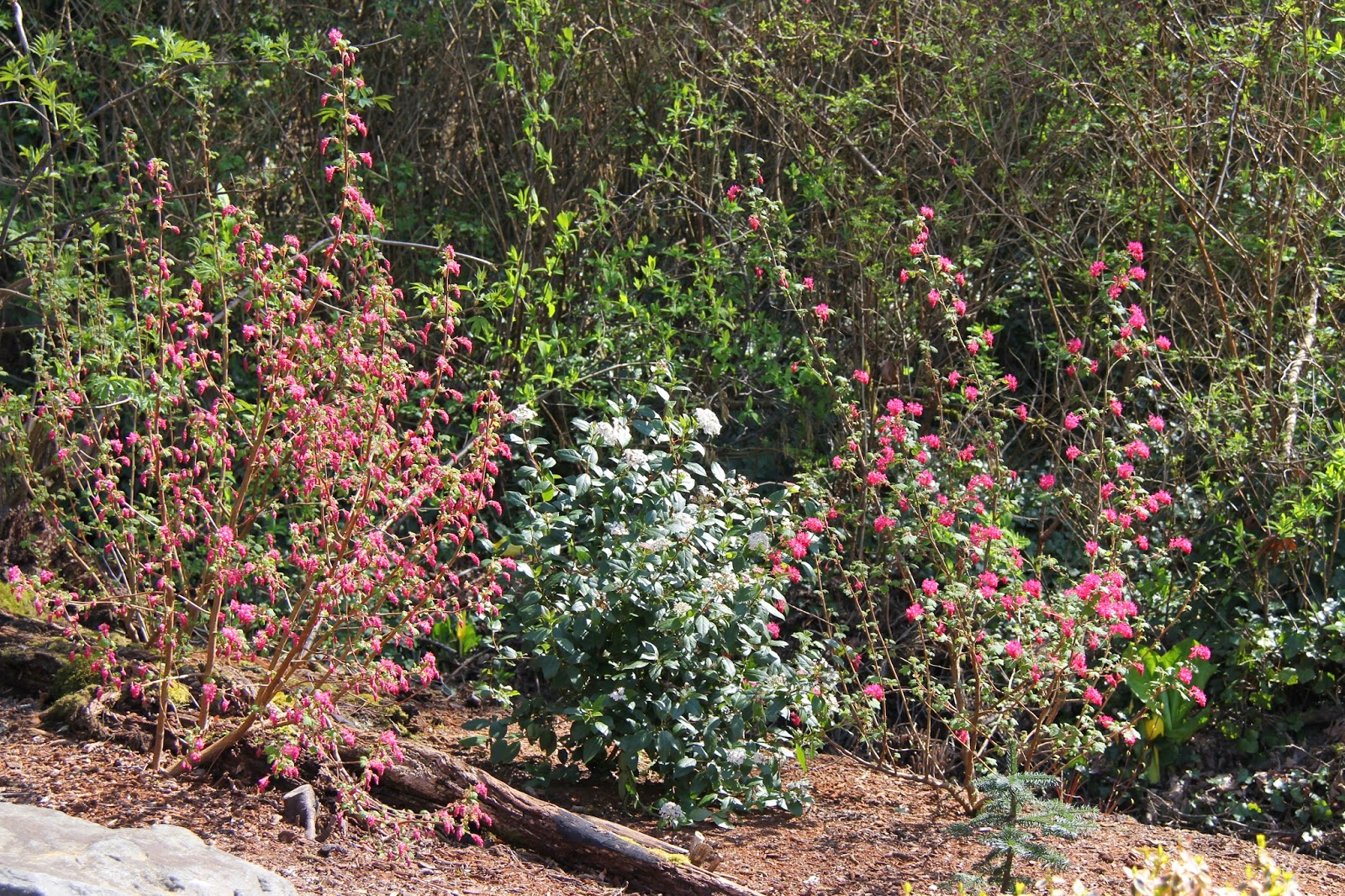
The birds and bees are happy that my red-flowering currant shrubs are blooming! I have more than 20 scattered around the hillside and native areas of my yard. They are a couple different shades of pink, as they are from different purchases from the Pierce Conservation Society native plant sales. They start out very small and grow quickly.


February 3, 2014

Moving plants

I took advantage of a mild winter day to get John's help to move a hydrangea that was going to be too large for its location next to the house. It also wasn't all that pretty either (can't remember the variety). So it got a new home on the lower hillside. I planted another Choiysa ternata in the hydrangea's old spot. Now I have three of them in the beds on either side of the front entry - a better plan/layout. I'm fond of of Choisya ternata, as it is a useful broadleaf evergreen, and it will happily take pruning as needed. I have the 'Sundance' variety in several places where the golden leaves add bright spots of color. And five 'Aztec Pearl' do a lovely job of providing year-round structure in my beds surrounding the lawn. Their fragrant flowers provide extra interest in early summer, continuing until fall.


January 20, 2014

Pruning and training grape vines

I worked with other master gardeners at the Neely Historic Garden in Kent on Saturday morning. We pruned the grape arbor and dig some other garden clean-up tasks. I had been feeling like it was too cold to work in the garden lately, but after I was outside in the sun, I decided I needed to get busy in my yard. Since I started the day pruning grape vines, I decided to tackle my vines. I have a Concord and Catawba that are three or four years old. My husband put in some metal fence posts to use for the main supports and to support the wires, which run horizontally at about three feet. Then I pruned according to the instructions in the following:
http://extension.wsu.edu/maritimefruit/Pages/GrapePruningBasics.aspx


After I finished with the grapes, I went on to clean up a couple garden areas, hoeing the little winter weeds and trimming up some spent perennials that had nothing left to offer the birds.
Now I'm off to rake some leaves, so I can fill up the yard debris bin before tomorrow's pick up! I started this yesterday and found it took quite a bit of time to rake or hand-pull leaves out from shrubs. It sure does look neater though!

Cleaning out catch basins

We had our favorite "excavator" Noel clean out the catch basin that is at the bottom of our little stream. Over the past seven years, it had nearly filled up with sediment, rocks, and debris that washed down the stream.
While it is never fun to have to pay for something like this, we have a responsibility to take care of these things that are on our property. When we saw what a big job it was, we were glad we had an expert take care of it! Noel had to unbolt the metal lid part(after clearing away some rocks), and place a pump  a little higher to divert some of the water. Then he cleared out the catch basin. I didn't see him working on it until late in the day, and he was six feet down in the basin! I didn't know it was so deep! It took him a little more than a full day to complete this job.

January 10, 2014

Insects in my worm bin - Springtails

Yuk!  I was about to put some lettuce in my worm bin and discovered millions of very tiny white bugs. I used a magnifying glass and took pictures, so I could get a closer look at them. I've determined they are Springtails and not harmful. But I think the bin is too moist, so I've added more shredded newspaper and dry leaves, and I am leaving the top off for while. Since there is uneaten food, I'm going to cut back on the amount of food I add to the bin. My worms seem to prefer lettuce over other produce, and we generate more than enough lettuce to feed them, so that is mostly what they get to eat.

Here is a photo of one of my red wigglers with masses of these tiny insects in the drainage tray.
Here is my worm bin, showing some of the leaves and shredded newspaper I added:

December 1, 2013

Prepping for the wind and cold

This morning, I prepared for the wind and the coming frigid weather. I moved some pots that are prone to topple in the the wind to more sheltered location. John moved a semi-tender Phormium 'Coordination' to the garage, along with the Camellia sasanqua. Too bad, since the Camellia is blooming, but I remember late November 2010 when we returned from Hawaii to find that all the buds had turned brown.
I gathered four more pots together in a sheltered corner and wrapped in "planket". This was Phormium 'Taya' and another 'Coordination', and two petite crape myrtles.

Yesterday, I enjoyed "gardening" with grandchildren Evie (one year old) and Isaac (two years old). I'm getting them started early! Here is a Thanksgiving Day photo of them sweeping:


November 21, 2013

Cleaning out the stream

Last week, I spent about 12 hours, spread over several days, cleaning up the stream area. I raked a lot of (mostly) maple leaves and hoed weeds from the general area. Then I got in the stream to clear out debris: more leaves, twigs, and weeds. Thank goodness for good quality rubber boots! Four days in a row, I got muddy from head to toe and enjoyed it!

The watercress had grown up a lot in the lower part of the stream, plus there was ivy to tackle, along with an assortment of other weeds. There used to be a lot of buttercup, but I've got that well under control now. And I keep cutting back the ivy, more each year.
When we had the heavy rains in October, a lot of water rushed down the stream, bringing debris with it. And there were a lot of maple leaves too.
I usually have trouble stopping once I get into a job, but I just worked a couple hours a day, sometimes in rain showers. While I still have some piles of leaves to remove and new alder leaves that fell (and are still dropping), the stream is in good shape.
I've been gradually adding plants to the bank, including deer fern, some other ferns, and candelabra primroses. Other ferns and bishop's cap are growing there naturally.


When I was taking pictures, I saw a hummingbird feasting on several of my hardy fuchsias. The photos are not very sharp, as I was not near him. Last week, I watched a hummingbird taking a bath in the upper stream - what a thrill!


November 14, 2013

Physocarpus (Ninebark)


Physocarpus (Ninebark) is a useful landscape shrub, with cultivars to suit most Northwest gardens. This graceful deciduous shrub is multi-stemmed, upright, and vase-shaped. Ninebark leaves are alternate and simple, with three-to-five lobes. Cultivars of this North American native plant have foliage ranging from chartreuse to purple. Clusters of reddish flower buds open to white or pink flowers in late spring and attract pollinators. In the fall, birds enjoy their small, seedy, and hairy berries. In winter, the striped peeling bark on mature branches demonstrates how Physocarpus got its common name of Ninebark.

Our native Pacific Ninebark (P. capitatus) is large and lanky, growing rapidly to 12’. In moist natural areas, it supports birds and pollinators, and its extensive root system is good for erosion control.

P. opulifolius cultivars provide outstanding color in landscape gardens. Diabolo® Ninebark (P. opulifolius 'Monlo') was the first purple Ninebark on the market. At 8’ x 8’, this shrub makes a great background plant. In the spring, clusters of white flowers provide a beautiful contrast to the dark chocolate to purple foliage. Add silver or white leafed plants nearby for additional contrast.

Coppertina (P. opulifolius 'Mindia') has spectacular copper-colored new foliage that ages to purple. It grows in a fountain shape to 8’ x 6’ and has light pink flowers. P. opulifolius ‘Center Glow’ has reddish purple leaves with golden centers that gradually turn burgundy. With white flowers, it has a graceful arching form to 8’ x 8’.

It is easier to find a place in the garden for the more compact 5’ Summer Wine (P. opulifolius 'Seward'), with orange springtime foliage transforming to burgundy (pink flowers). Even smaller at 4’ x 3’, the dwarf Little Devil (P. opulifolius 'Donna May') has rich burgundy-purple leaves with pinkish-white flowers.

Contrast purple-leafed Ninebarks with gold, chartreuse, or variegated foliage plants; or with bright hot-colored flowers or foliage, such as lilies and cannas. In a large landscape, break up too much green with a group of three to five purple Ninebarks.

Introduced to market in 2013, Amber Jubilee (P. opulifolius ’Jefam’) produces spring growth in shades of yellow and orange, contrasting with lime green foliage on mature branches. Fall foliage is red and purple, with size of 5’ x 4’. Similarly sized, with yellow to lime green foliage, both P. opulifolius ‘Dart’s Gold’ and P. opulifolius ‘Nugget’ have white flowers. Afternoon shade protects gold-leafed types from leaf burning. Pops of gold and chartreuse foliage brighten landscape areas.

Ninebarks are low maintenance plants that adapt to a range of conditions – from sun to part shade, dry to moist, acidic to alkaline, and nutrient-rich to poor soils. Prune occasionally to remove damaged branches or to shape the plant. Remove old canes during dormancy to stimulate growth of vigorous new branches with more flowers and better leaf size and color. (You may do renewal pruning biannually to restrain plant size.) Plant a new Ninebark in your landscape!

This photo shows the new growth on Coppertina. I have three of these in my lower driveway berm.

This is the same Coppertina in the fall. Note the dramatic change in leaf color.
 Here is our native Ninebark (Physocarpus capitatus), planted in my native plant area:
 This photo shows the golden leaves of the Nugget. It is planted in my lower driveway berm.

November 10, 2013

WSFGC Holiday Show

I participated in my first state flower show, the Washington State Federation of Garden Clubs Holiday Show in Everett. I entered a creative illuminated design and got a second place (90+ points).
 I entered 15 horticulture specimens and got 13 blue ribbons and 2 reds. My Fuchsia 'Constance' got an Award of Merit (best in section), and my Cryptomeria japonica 'Black Dragon' got Elfin award (best dwarf)! I feel great about my first big show!

October 28, 2013

Ginkgo biloba 'Mariken' and Callicarpa 'Profusion'

I just took pictures of my dwarf ginkgo and beautyberry plants, as they are each showing off their fall colors. Both plants are planted in my upper driveway area, where they are easily viewed. We need to see our fall/winter interest plants!

I have two of the Profusion Beautyberry pants. This one was a gift from my mom, as were many of my special plants, so I remember her as I walk through my garden. It is packed with berries now, and they will thin out as the birds discover them.
 I have two dwarf ginkgo plants in pots and one in the ground. This one is doing so well. It has been in this pot next to the driveway for about three years. I add small plants around it, such as these heuchera and callibrachoa (in spring/summer). It gets plenty of sun and is watered in summer with drip irrigation. The gold color of its fall leaves is striking. I hope the leaves stay on a little longer for us to enjoy it.

October 20, 2013

Overwintering hardy bananas in storage room this year

I was going to wrap the bananas this year, so they would grow taller next year, but I decided to dig them up and keep in pots in my storage room. It seemed easier, and I can divide and have more plants.
So here is how they look after a messy job. I had John's help digging, which was wonderful.

Replaced Cornus florida with a Hamamelis int. 'Diane'

With help from John, I dug out the Cornus florida (the type of flowering dogwood that is so prone to Anthracnose). I bought a witch hazel to replace it. These need about 12' x 12', so this space should be nice for it. It will have a nice background of arborvitae.

October 19, 2013

Viburnum plicatum tomentosum 'Mariesii' - Doublefile viburnum

A quick post with a photo of my hillside, showing the lovely color of the double-file viburnum. This variety starts turning a lovely bronze color in July! The first year, I thought they were planted in too much sun, so I moved them from their original location to the hillside. Then I learned that the color change is a feature of this variety. Well, I am happy to have them as a feature planting on my hillside. I started with five plants, but I now have seven, because I started some new plants from cuttings. I am lucky there is plenty of room for them in this location. I like to place plants where they have room to grow to their mature sizes (and beyond) without having to prune. They look much better in their natural shape, and it is less work.

The photo also shows the hardy fuchsia 'Army Nurse', still blooming away. I just counted and discovered I have 21 different varieties of hardy fuchsia growing in my yard (three plants of most varieties).


Japanese-inspired garden in 4 seasons

I submitted the following photos of this little garden area for a contest about seasonal gardens.

Summer:

Winter:

Spring:

 Fall:

Callicarpa bodinieri 'Profusion' - Beautyberry plant

My Beautyberry plant is looking great now. It will also look striking when the leaves fall off, leaving just the iridescent purple berries (until the birds eat them). I have two bushes, and I just bought two more to give as gifits to my lovely daughter-in-law and to her mother.


October 6, 2013

Young hummingbird (and over-wintering tender plants)

I was able to get pretty close to a young hummingbird just now, while resting on my palm.  He (or she?) is fluffy, so that's why I think it is juvenile. I especially liked getting the photos with open beak.


It's probably early to do this, but I got my tender plants inside my storage area. I cut back more than half the Brugmansia (Angel's Trumpet). I'm going to try to over-winter Mandevilla this year. The begonias are in vermiculite.