October 14, 2014

Harvesting Mason Bee Cocoons

Last weekend, I harvested my mason bee cocoons. I bought 10 cocoons (6 male and 4 female) last winter and refrigerated them until March. Then I put them out in an assortment of cardboard tubes and reeds in a little house. They woke up in the later part of March and were busy until around mid May. Since I harvested more than 160 healthy cocoons, I'm sure that quite a few native mason bees found my house and decided to lay their eggs there. I have a great location for mason bees (Blue Orchard Bees, or BOBs), since I have my little stream where they can get the mud needed to separate the egg chambers.

Here are photos I took during the harvest process. It was a little more difficult than I expected to get the tubes open. The reeds are much easier, so I went to Crown Bees in Woodinville and exchanged about 120 of my excess bees for a bunch more reeds for the spring.

It took me about 90 minutes to harvest the cocoons. This was my first time, so I think it will take less than half the time next year.

This photo shows the assortment of tubes I used and the first few cocoons I harvested:
 This shows some of the opened cardboard tubes:
 This is an opened reed. They are quite easy to open up. You can see the cocoons separated by plugs of mud. The black specks are bee feces.
The orange "dust" is pollen mite feces, which I found in a few of the tubes/reeds. I discarded the orange dust and the cocoons that were next to it.

 Here are my harvested cocoons. I brushed off most of the black specks (feces), but it doesn't hurt to leave some, so I didn't bother with any unnecessary work.

I kept about 30 cocoons and took the rest to Crown Bees for them to distribute to others who want to raise mason bees. They are working on getting more farmers (such as almond and cherry growers) to use bees as an additional type of bee.

The bees I kept are stored in the refrigerator until March. I put them in a little yogurt container, which rests in a larger container with some water in the bottom so they won't get dehydrated in the refrigerator. Then a poked holes in the plastic lid of the container, so they will get air. A no-cost way to safely store the bees while hey hibernate.

Harvesting bees will increase the numbers of healthy bees that survive.

Fall in the garden

Spiders are everywhere! I have to remember they are beneficial, especially when I'm walking into webs, and getting the occasional bite.

The double-file viburnum are changing to a lovely burgundy color. And they have a small second bloom. The white flowers really contrast with the dark leaves.

The bright golden-chartreuse of Ginkgo biloba "Mariken" (dwarf ginkgo) provide a bright pop of color.


The Beautyberry is giving a hint of the spectacular purple berries that will stand out when the leaves drop. In the meantime, the leaf color is nice. I have three plants, but they are still small. They will grow to about 6 feet.


Here is a photo of John taking out the Scarlet runner bean plants. The hummingbirds are still finding plenty in the garden, with the hardy fuchsias and salvias.

September 10, 2014

Hardy Hibiscus and Autumn Crocus

A couple photos of plants in my garden in September - Colchicum autumnale (Autumn Crocus) and Hibiscus sp. 'Lord Baltimore' (a hardy hibiscus that grows like a perennial here):

September gardens at Point Defiance

I went to Point Defiance park a week ago and enjoyed the gardens - the borders and the dahlia, fuchsia, and rose gardens. I encourage you to visit sometime this month while there is so much blooming, and the borders look so good.


A few photos of fuchsias I liked:


Some pictures with bees in the flowers. The first is Actaea (Bugbane). The remaining are dahlias:


August 14, 2014

Rabbits!

I have a love/hate relationship with rabbits this year. We had not seen rabbits in our yard until last year, when we would get one or two who visited occasionally and just seemed to eat a little grass. I think the coyotes and hawks had kept them under control in past years. This year, we are getting more full grown rabbits and rabbit babies. They have been feasting on my perennials and annuals, and it looks like some will not recover. They especially like tender new growth.

This photo shows how they have eaten the lower sections of scarlet runner beans. They are recovering and giving us more beans than we can eat. Other plants aren't doing as well.

At this point, my strategy is to plant more plants, so there are enough for the rabbits to eat and for me to enjoy. I will also pay attention to plants they don't favor, and I may increase these. For example, they don't seem to eat salvias and agastache. I had thought they were leaving the hardy fuchsias alone, but it appears they've chewed out a section of a newly planted one.

I may need to try fencing some areas next year, to protect newly emerging plants.


An unusual bumblebee

I first saw this bee two years ago, and it is now a common site in my garden, especially when the Rose of Sharon bloom. It is a bit larger than the black/white and yellow/black bumblebees that are my most common bees. I like the rusty color.


 In the photo below, "Rusty" is settled in, and a black/yellow bee comes for pollen, then quickly leaves.
 They get covered with pollen!

Silene regia 'Prairie Fire' - Prairie Fire Catchfly

When blooming, the hummingbirds favor this plant above all others, including the scarlet runner beans and fuchsias. Silene regia 'Prairie Fire' is a perennial that likes full sun and does not require much water. In the tropical area of my garden, it gets plenty of sun and water, so it grows 7 feet tall! It must be well- supported with tall stakes and ties. I placed a large obelisk over it, then added additional ties as needed. Visitors to my garden always want to know about this plant, which is the tall plant with orange-red flowers in the photos below.

August 1, 2014

A few photos of the late July garden

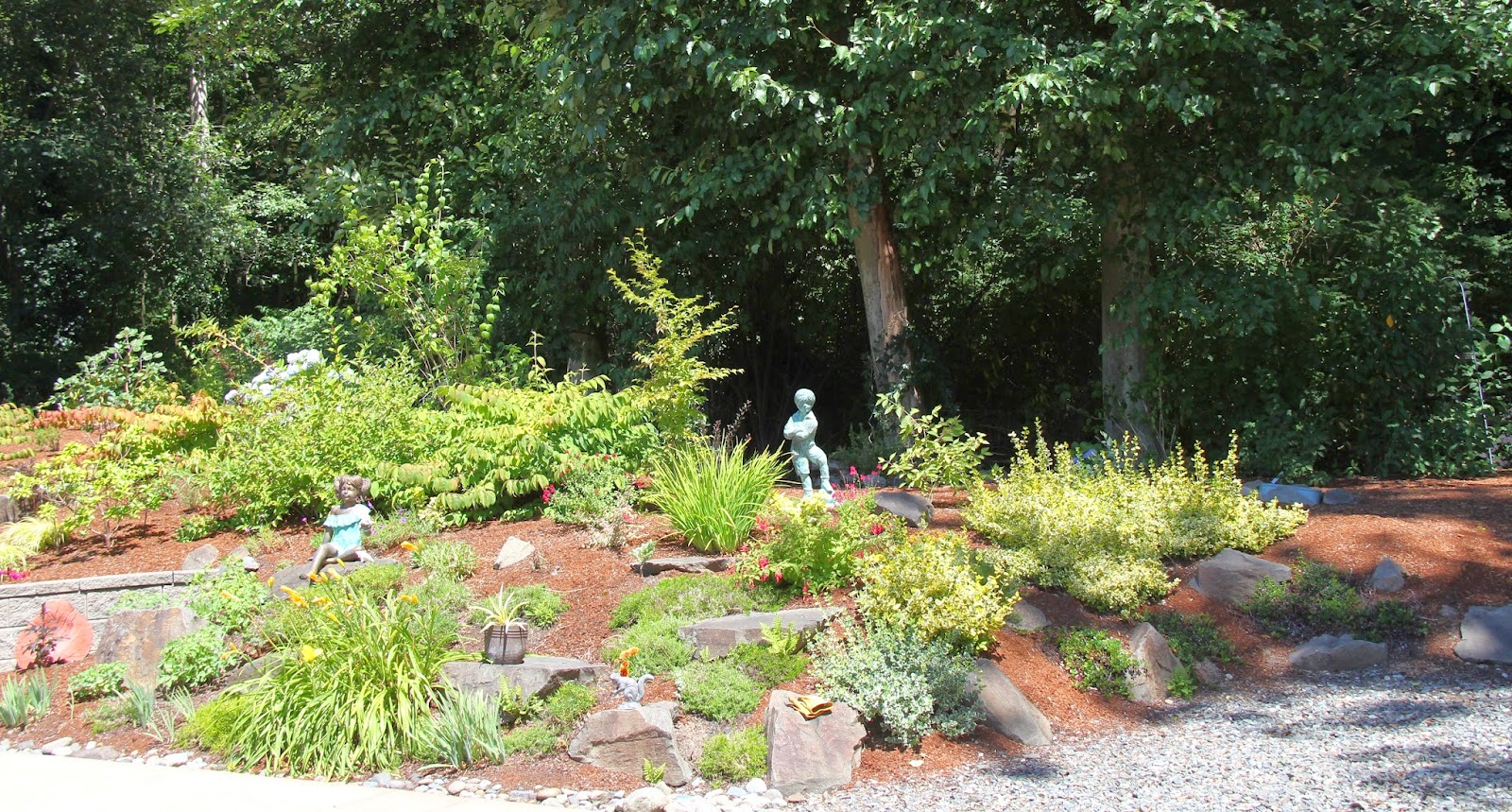
Last weekend, John helped me with weeding out the watercress and horsetail from the stream. How nice to have help with this big job, so it only took about two hours. I'd weeded the upper half of the stream the day before - hoeing areas with small weeds and hand-pulling the larger weeds. And John weed-whacked some of the ivy trailing from the neighbor's side of the stream. Here are some photos of the garden.


July 17, 2014

My little garden helper

I can't resist posting a few photos of my oldest granddaughter in the garden.