
June 13, 2011


Hardscaping with Stones
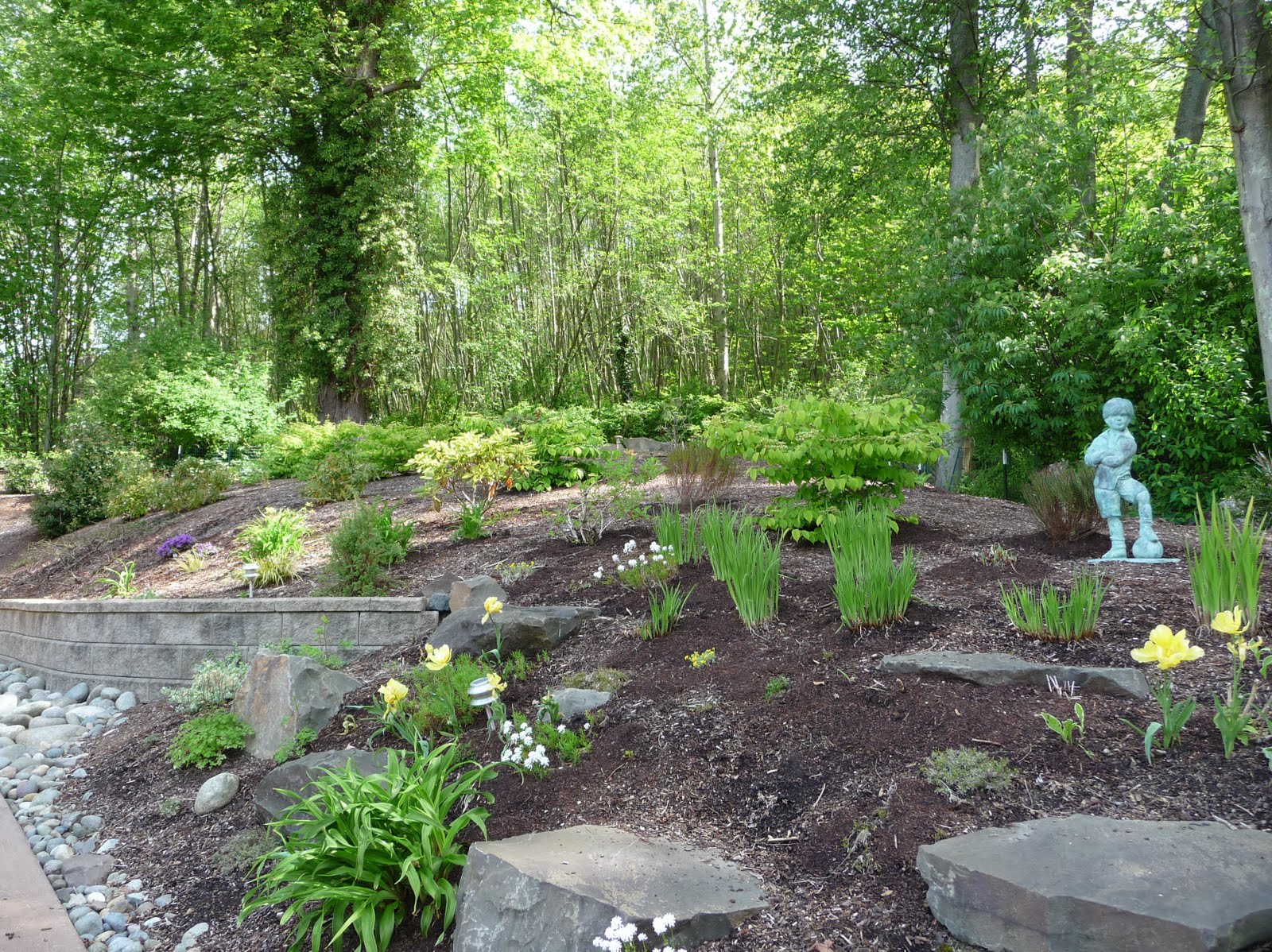
Last week we had our favorite "excavator" guy, Noel Hess, bring and install two truckloads of 3 - 4 man rocks. He created four solid steps up to the hillside garden area. He also installed about 20 big rocks in the large berm area along our lower driveway, and he placed more on the upper berm and hillside.
This weekend we shoveled 35 yards of bark! I was pretty careful to keep away from most plants. I had put compost around many landscape plants a couple weeks ago.
Here are some photos showing the results of our work this week.
 You can see the new steps on the right:

This is the "berm" next to the lower driveway:

Here are two photos of Noel at work on the steps:


This weekend we shoveled 35 yards of bark! I was pretty careful to keep away from most plants. I had put compost around many landscape plants a couple weeks ago.
Here are some photos showing the results of our work this week.


This is the "berm" next to the lower driveway:

Here are two photos of Noel at work on the steps:


June 2, 2011
Doublefile Viburnum - my favorite landscape shrub
The Doublefile Viburnum look fabulous on the hillside. In fall 2009, I started some additional ones from cuttings. These are doing well as they get well established.
These bushes look terrific in May when blooming, but they are such a lovely shape that they look nice through fall. As a bonus, in late summer the leaves turn a striking bronze.

These bushes look terrific in May when blooming, but they are such a lovely shape that they look nice through fall. As a bonus, in late summer the leaves turn a striking bronze.

Lupine
On May 20 I planted five new blue Lupine plants in the lower garden area in SW corner. I will add more later to create a bed that is striking when someone walks up my driveway. I added three more and think I will still add another five or seven.


Dutch iris
Here is a photo of the first Dutch iris to bloom in my garden this spring. It was taken May 20, which is later than usual due to our cool spring weather. Several Heuchera surround the iris in this bed near the walkway to the front door.


May 13, 2011

Clearing brush to gain access to stream
I've been clearing out some brambles and branches and other debris to gain access to the stream from the upper garden area, in the lower part of the hillside. Here is a peak at the stream from here. I added some rocks enhance it. A fun little project to work off stress!


Spreading compost
I spread compost around many of the plants on the hillside. The soil is very poor - mostly dirt from house construction that was moved to the hill. It was a blank slate four years ago, and I selected plants that would do well in clay soil on a hillside in part sun or shade. Most of the plants are native shrubs. There are also about almost 20 viburnums (double-file and tinus), which are thriving in this environment. A few rhododendron and azalea are doing fine, even though the soil is not very well-drained.
I will post a photo when the double-file viburnums get into full bloom, as I think they will be spectacular in a couple weeks.

I will post a photo when the double-file viburnums get into full bloom, as I think they will be spectacular in a couple weeks.
May 6, 2011
Container planting
It is finally time to plant your containers for summer show! Well, all except some of the more tender annuals, such as sweet potato vine (Ipomea), impatiens, and begonias. These will stay in my garage for another week.
I over-wintered non-stop begonias (in vermiculite in my storage area). In March I planted them in pots and brought most of these inside. They will stay inside for another couple weeks.
I've brought all the over-wintered plants outside, except for the angel's trumpet. I repotted several plants, such as pony-tail fern and abutilon. They just seemed to be calling out for fresh potting soil.
I over-wintered non-stop begonias (in vermiculite in my storage area). In March I planted them in pots and brought most of these inside. They will stay inside for another couple weeks.
I've brought all the over-wintered plants outside, except for the angel's trumpet. I repotted several plants, such as pony-tail fern and abutilon. They just seemed to be calling out for fresh potting soil.
Red Apeldoorn Tulips
Have you experienced frustration from tulips not coming back the second year? Try planting the Red Apeldoorn Tulip. They are readily available in the fall. I bought mine inexpensively on two different years in big bags at one of the box hardware stores. These tulips come back better each year!
They appreciate our wet fall/winter/spring weather, but don't want much water during the summer. Well, that is great for our climate!
Try planting a patch this fall!

They appreciate our wet fall/winter/spring weather, but don't want much water during the summer. Well, that is great for our climate!
Try planting a patch this fall!

Spring garden images
Here are a few photos showing parts of my garden in early May. This dogwood is just starting to bloom.

I appreciate the beautiful light green shades of new growth.

A new hanging begonia with emerging perennials behind.

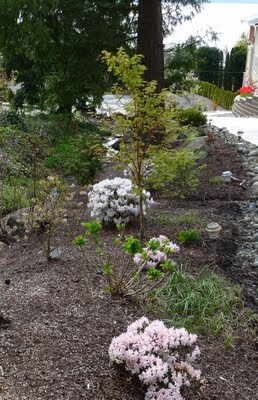
Berm between the driveway and the little stream, showing some small rhododendron, blueberries, coral bark maple, vine maple, hydrangeas, evergreen huckleberry, and hebes.
 A pot of tulips by the upper driveway. Even though they will not come back next year, it is worth planting for the spring show. This fall, I crowded a bag of double tulips in the pot. I planted another bag of yellow tulips in the hillside rock garden (which needs more plants!).
Today I've been clearing brush to the area on the right and behind the steps. This will give easy access to the stream. But I got into some kind of bramble that gave me a rash on my arms. Had to come inside to wash up and apply anti-itch cream. Fortunately it worked right away!
We are going to have some bigger stones set for a more solid set of steps up to the hillside. This will provide safer access to this part of the yard.


I appreciate the beautiful light green shades of new growth.

A new hanging begonia with emerging perennials behind.

Berm between the driveway and the little stream, showing some small rhododendron, blueberries, coral bark maple, vine maple, hydrangeas, evergreen huckleberry, and hebes.

Today I've been clearing brush to the area on the right and behind the steps. This will give easy access to the stream. But I got into some kind of bramble that gave me a rash on my arms. Had to come inside to wash up and apply anti-itch cream. Fortunately it worked right away!
We are going to have some bigger stones set for a more solid set of steps up to the hillside. This will provide safer access to this part of the yard.

Native plants - Elderberry and Red Flowering Currant
Here is a picture of a red-flowering currant that I took last month. Yikes - I've been remiss about posting. I planted dozens of various native plants in February 2010. They came as small plants from the county conservation society, but they have grown quickly and are thriving. Most of them are not in irrigated areas, so get watered infrequently - or not at all.


This is the native elderberry. My "native" landscape areas are doing great in poor soil with almost no attention. The red-twig dogwood is another winner in dry or moist soil, and in sun or shade.

March 16, 2011
A few March garden activities
Ferns: If you have ferns and have not yet trimmed the old fronds, do it now so the new ones won't get in the way. In a few weeks, your ferns will look great. This photo shows the new fronds curled up tight (for now).

Hardy fuchsia: Trim the old wood. New growth will come from the roots, and the plant will look better in the spring and summer. This photo shows new growth coming from the bottom of one fuchsia, but most of mine don't show much new growth yet.

Hostas: Clean up any old leaves and twigs. The new growth is just beginning, and the slugs will go crazy. Use an iron phosphate slug bait, such as Sluggo, which is not harmful to animals.

Hardy fuchsia: Trim the old wood. New growth will come from the roots, and the plant will look better in the spring and summer. This photo shows new growth coming from the bottom of one fuchsia, but most of mine don't show much new growth yet.

Hostas: Clean up any old leaves and twigs. The new growth is just beginning, and the slugs will go crazy. Use an iron phosphate slug bait, such as Sluggo, which is not harmful to animals.
March 7, 2011
Pruning Roses
I worked in between rain showers and got my roses pruned (along with the roses at Foundation House). I had four or five roses that had to be replaced due to winter damage. Well, two of them were actually poor performers, because I had not bought a high enough quality plant last year. I bought four bare root plants and one potted. Hybrid Teas: two Pascali (white) and one Olympiad (red). Grandifloras: one Dick Clark (multi-colored cherry, pink, cream ) and one Gold Medal (Golden Yellow).
Planting:
I soaked the bare root rose bushes, then trimmed the roots and some of the branches (to just above outward facing buds). I mixed some compost with castings from my worm bin and soil, and I added alfalfa meal and super phosphate. This mixture went in a little mound in the bottom of the hole. I spread the roots over the mound, filled in about 2/3 of the hole, watered, and filled in the rest.
Pruning:
I removed the dead, diseased, and tiny canes (also those that faced inwards). I trimmed the remaining (generally three to five) strong canes to 1/4 inch above an outward facing bud and down to where the pith was creamy colored. Finally, I removed any old leaves and raked debris from the bed (to help prevent disease).

Planting:
I soaked the bare root rose bushes, then trimmed the roots and some of the branches (to just above outward facing buds). I mixed some compost with castings from my worm bin and soil, and I added alfalfa meal and super phosphate. This mixture went in a little mound in the bottom of the hole. I spread the roots over the mound, filled in about 2/3 of the hole, watered, and filled in the rest.
Pruning:
I removed the dead, diseased, and tiny canes (also those that faced inwards). I trimmed the remaining (generally three to five) strong canes to 1/4 inch above an outward facing bud and down to where the pith was creamy colored. Finally, I removed any old leaves and raked debris from the bed (to help prevent disease).

February 22, 2011
Grooming Hellebores
I trimmed the old leaves from my three Hellebores located in a bed near the front door. They like the small amount of morning sun they get here. Their location partially under the eaves keeps the soil from getting too soggy.
Trimming the old leaves helps prevent the Botrytis fungus. It also allows us to better see the flowers, which appear in the winter.

Trimming the old leaves helps prevent the Botrytis fungus. It also allows us to better see the flowers, which appear in the winter.

February 8, 2011
Early iris

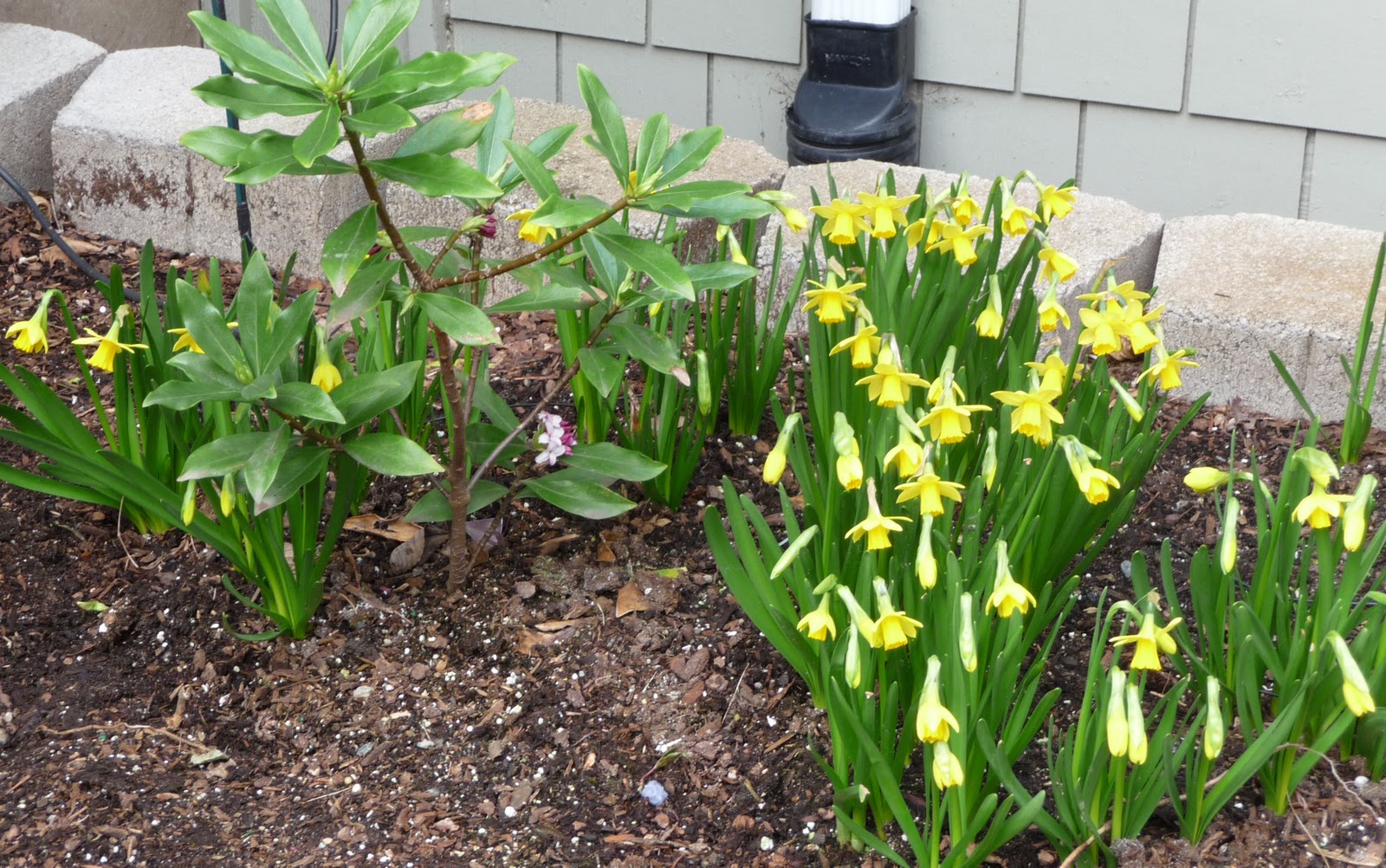
The Daffodil Tete-a-Tete are just starting to bloom. If you don't have any, buy some in pots in the grocery store (or nursery) to enjoy some late winter bloom. After they finish blooming, plant the bulbs in a flower bed where you would like to see them next year.
January 23, 2011
A busy weekend of winter gardening activities
I took advantage of some dry days to get back out in the yard. After helping other master gardeners prune grapevines at Neely Homestead Garden Saturday, I got inspired to come home and do some winter gardening. At two years old, my grape vines only needed a couple cuts!
I spent a couple hours walking through the garden beds and hoeing the little weeds that were trying to invade. I did a little trimming of spent perennials that I hadn't trimmed in the fall. I also cut some dead branches from the rose bushes and cleaned up the New Zealand Flax (Phormium).
Saturday afternoon, I pruned the weeping birch tree at my son Steve's house. From the inside, I hand-combed out little dead branches. Then I cut out dead and crossing branches, and a couple branches that were wildly going too far up. It looks great! It is so much easier to do this type of pruning when the leaves are off the trees.
On Sunday, I walked all through the hillside, the driveway berm, and the native plantings on the north side with my hoe and pruning clippers. There were surprisingly few weeds, but it felt great to get everything tidied up. I clipped the fronds off the ferns - they will look great when the new fronds unfurl in early spring. I trimmed a few stray branches on shrubs and small trees.
I spent a couple hours walking through the garden beds and hoeing the little weeds that were trying to invade. I did a little trimming of spent perennials that I hadn't trimmed in the fall. I also cut some dead branches from the rose bushes and cleaned up the New Zealand Flax (Phormium).
Saturday afternoon, I pruned the weeping birch tree at my son Steve's house. From the inside, I hand-combed out little dead branches. Then I cut out dead and crossing branches, and a couple branches that were wildly going too far up. It looks great! It is so much easier to do this type of pruning when the leaves are off the trees.
On Sunday, I walked all through the hillside, the driveway berm, and the native plantings on the north side with my hoe and pruning clippers. There were surprisingly few weeds, but it felt great to get everything tidied up. I clipped the fronds off the ferns - they will look great when the new fronds unfurl in early spring. I trimmed a few stray branches on shrubs and small trees.
Elephant Ear plant
The Elephant Ear plant I brought inside for the winter is doing great. It is a few feet from south and west-facing windows.


Sarcococca ruscifolia
The Sarcococca are blooming now and highly fragrant. I think it usually blooms in February, so might be a little early this year. The hummingbirds like the flowers, so I am happy to have six of these for their winter feeding.


December 6, 2010
Sprucing up the winter garden
I came home from vacation to see the results of wind storms and cold weather. We had many leaves to rake up - happily John did much of this clean-up. I trimmed a lot of dead foliage from perennials.
I planted two lemon cypress trees in pots on front porch. I put twigs from red twig dogwood in other pots to give them some structure and color. These may root, providing a bonus of some super plants to give away.
The Callicarpa bodinieri (Profusion Beautyberry) looks great, with iridescent purple berries.


I planted two lemon cypress trees in pots on front porch. I put twigs from red twig dogwood in other pots to give them some structure and color. These may root, providing a bonus of some super plants to give away.
The Callicarpa bodinieri (Profusion Beautyberry) looks great, with iridescent purple berries.


November 13, 2010
Garden clean-up
I took advantage of a nice November day to clean-up the lower garden beds. I was surprised how many things are still blooming or at least green and not quite ready to cut back. I took out the remaining scarlet runner bean plants, leaving the roots to enrich the soil. I cut back or trimmed a lot of perennials. I cut back a few of the fuchsia, but left most of them as they are still blooming and attracting many hummingbirds. I saw a charm (flock) of about 15 hummingbirds yesterday.
John pulled out the watercress that was covering the creek, so the birds will be happy again!


John pulled out the watercress that was covering the creek, so the birds will be happy again!


October 31, 2010
fall trimming
Trimmed iris, daylilies, and hosta.
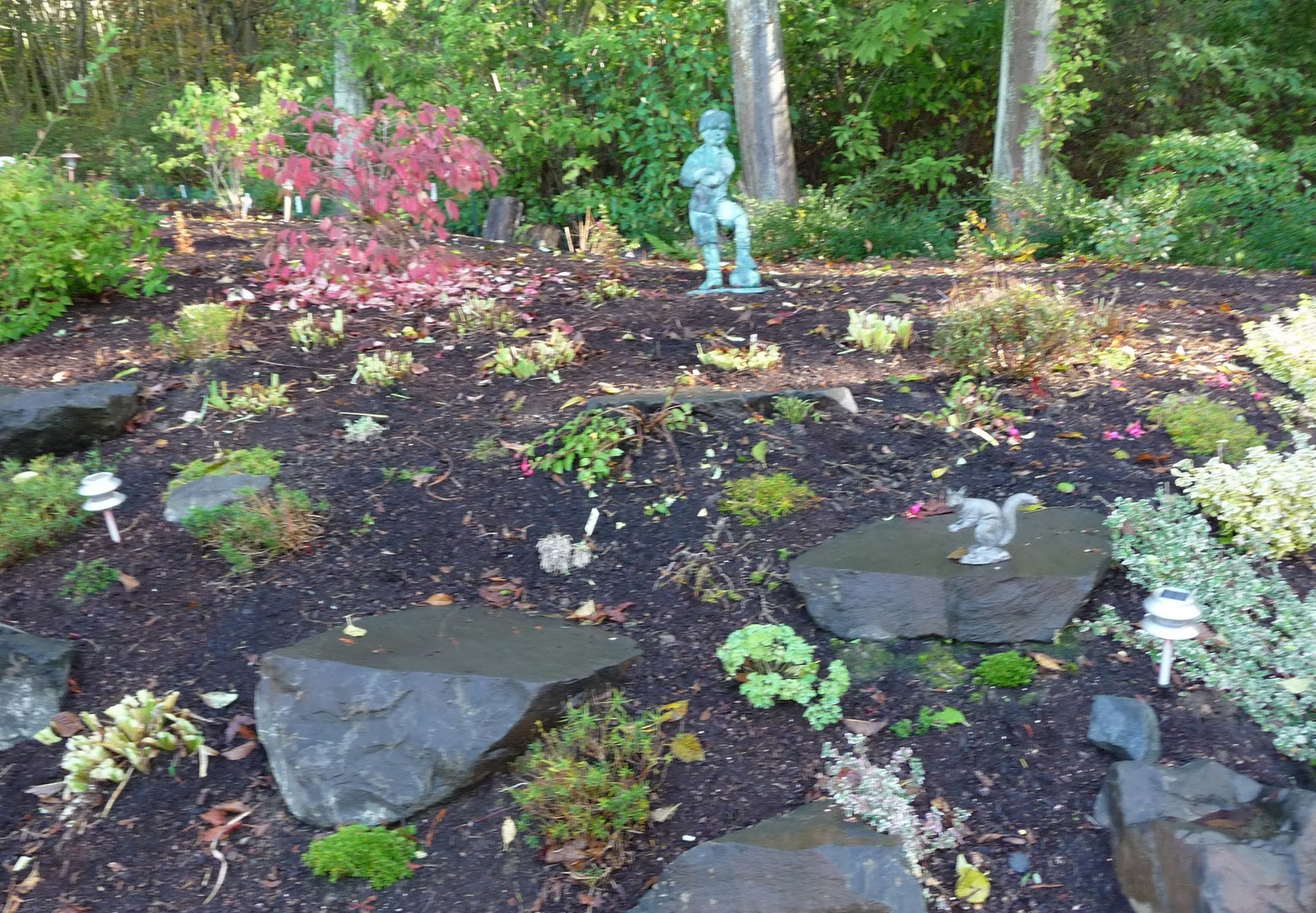
Photos of the hillside and front walkway showing today's trimming.


Photos of the hillside and front walkway showing today's trimming.

October 23, 2010
October chores
Scrubbed pots from spent annuals and tomatoes. Stored some non-stop begonia bulbs in vermiculite (after letting them dry out in the storage room for a couple weeks). Still enjoying a couple others on the porches that are in full bloom, so obviously will wait to store them.
Discovered that I did get some "hairy" seed pods in my hairy balls plant. I dug it up and put it in one of my cleaned-out pots. I will move it to the storage room when it gets colder, as it is zone 8 and we expect a cold winter. I also moved the Elephant Ears plant to the family room so it will be a house plant for the winter.


My passion flower was not performing (no flowers for two years), so I lost patience and moved it to a less desirable spot, next to a tree on the back hillside. I planted a clematis in its place that Patsy gave me (she didn't have a sunny enough spot for it in her garden).
I dug up and potted a couple hardy fuchsia that are a bit more tender (Jim Fairglo) and put in storage room. Also moved the red banana and two Angel's Trumpets into the storage room. I'm glad it is such a large room, as I will have a lot of plants in it.
Discovered that I did get some "hairy" seed pods in my hairy balls plant. I dug it up and put it in one of my cleaned-out pots. I will move it to the storage room when it gets colder, as it is zone 8 and we expect a cold winter. I also moved the Elephant Ears plant to the family room so it will be a house plant for the winter.


My passion flower was not performing (no flowers for two years), so I lost patience and moved it to a less desirable spot, next to a tree on the back hillside. I planted a clematis in its place that Patsy gave me (she didn't have a sunny enough spot for it in her garden).
I dug up and potted a couple hardy fuchsia that are a bit more tender (Jim Fairglo) and put in storage room. Also moved the red banana and two Angel's Trumpets into the storage room. I'm glad it is such a large room, as I will have a lot of plants in it.
October 19, 2010
Hardy fuchsia
Here are a couple photos of hardy fuchsia that still look great in October: Army Nurse and Golden Herald. These Golden Herald were planted from little starts in the spring, so they will get bigger but will stay a nice manageable size.


Fall color


October 11, 2010
Some of my favorite plants
For our master gardener group meeting tonight, we are bringing lists of our top ten plants. The following are the plants that are some of my current favorites. I don't have any trees on the list, so I will have to provide a list of favorite trees later!
1. Mariesii Doublefile Viburnum
A great large shrub with clusters of brilliant white flowers sitting on top of horizontal branches (in May). Give it plenty of space, so you only have to trim out the occasional branch that goes astray. Leaves turn bronze in late summer and get brighter in fall. Viburnums are very happy in clay soil, so this is great for some of those problem areas (like my hillside). I also like Viburnum tinus ‘Spring Bouquet’ for its clusters of flowers in the winter, followed by purple berries - and that it is evergreen.
2. Red-twig dogwood (red-osier dogwood)
A great native plant that you can put in just about any condition of soil or light. Like the double-file viburnum, give it space. The newer branches are a brilliant red, so prune enough to get plenty of color and for shape. You can easily start new plants by placing cuttings in the ground in early fall. They have clusters of small white flowers, followed by berries. Other terrific native plants include red flowering currant, ninebark, and elderberry.
3. Burning bush (Euonymus alatus)
Maybe this is ordinary, but it is a lovely shrub. It turns a striking red in the fall, and the green leaves in the spring and summer are very nice. As with the other shrubs listed, give it enough room, so you can enjoy its natural rounded shape. It will take pruning pretty well, but much nicer if it is placed where you don’t have to prune it.
4. Abelia x grandiflora 'Kaleidoscope'
This abelia is compact and fits nicely into a landscape around perennials to give year-round structure and color to the garden. It has small, glossy, yellow leaves with green centers and a rosy orange-red blush. It is happy in full sun and part shade, but will be more colorful in the sun.
5. Clematis ‘Jackmanii’
If I can have one climbing plant, it will be a clematis. Plant in the sun with a tall structure to climb on. For a good-shaped plant, in early spring (or late winter) cut the vines back nearly to the ground, leaving at least one pair of healthy looking buds on the trunk.
6. Hosta ‘Gold Standard’
This hosta can’t be beat to light up a shady area – plant at least three. There are lots of great hostas, so plant a few varieties if you have enough shady areas.
7. Agapanthus
Any of the blue varieties are wonderful for the perennial bed. Big clusters of flowers rise above strapping leaves. Hummingbirds like them and will often find a perch on the stems. The leaves seem to be some of the longer lasting in the perennial bed. Plant agapanthus in full sun to partial shade in good well-drained soil. I haven’t planted them in pots, but understand they like to have their roots crowded and will bloom well in pots. I will this a try!
8. Liatris spicata
A perennial that fits in anywhere. Tall spikes of purple flowers bloom July to September. Full sun, well-drained soil. Easy to divide.
9. Heuchera
I like the purple varieties for the front of perennial beds in sun or part shade. They keep their leaves all year to provide some year-round structure in garden beds. Trim unsightly leaves. I often trim the flower spikes, as the leaves are the primary feature I want for my garden.
10. Hardy fuchsia
Select a variety that doesn’t get too large from among those that are the hardiest varieties. Some good choices include Santa Claus, Golden Herald, Army Nurse, Dying Ember, Flying Cloud, Pat’s Dream, Little Ronnie, Drame, Maxima, and Pixie. They bloom from July to November, giving that much-needed late summer and fall color. Hummingbirds love them. They work well in garden beds and in large pots.
October 10, 2010
Wheels for large pots
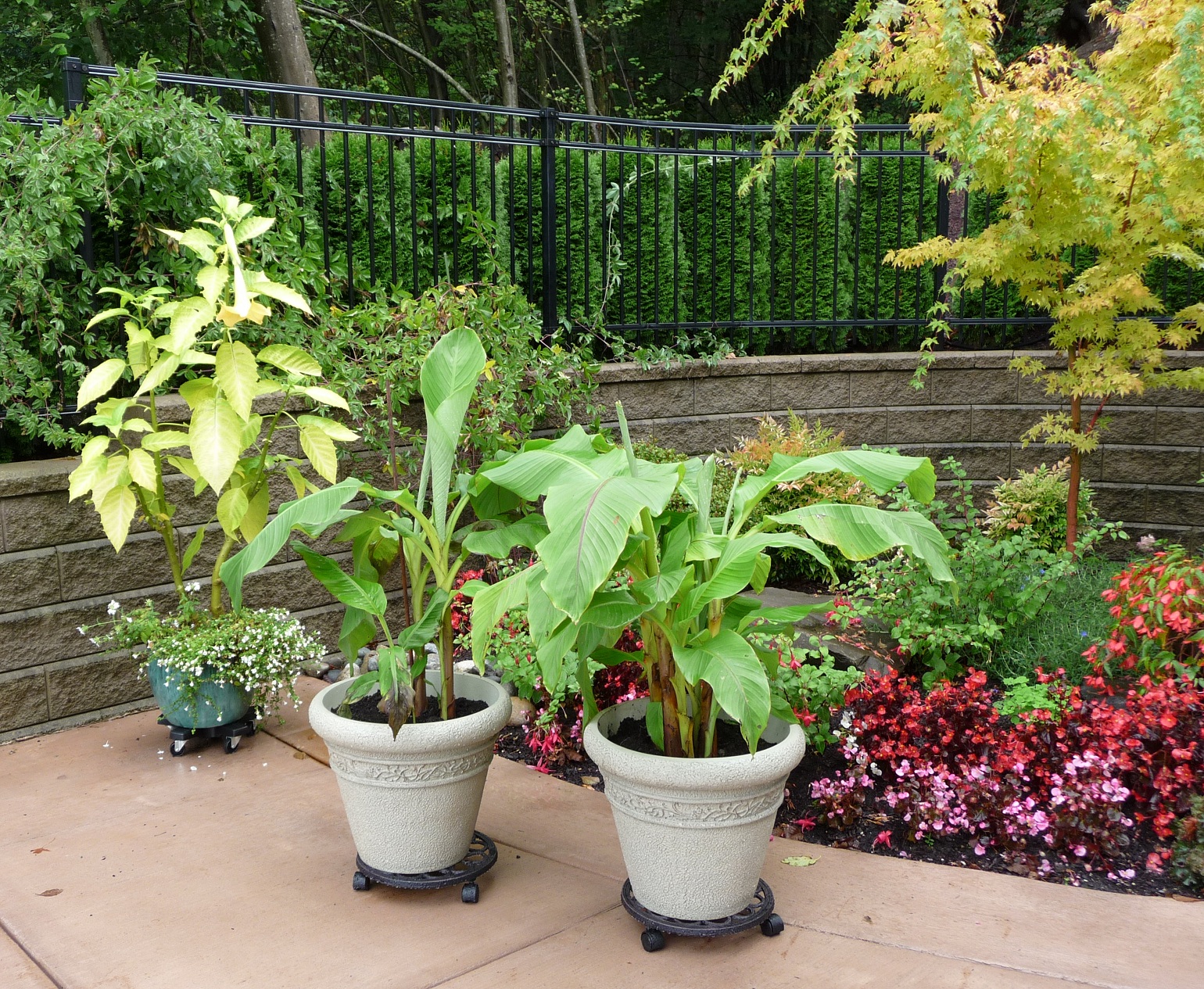
John got me more wheeled plant stands for some of my large pots that I want to bring into the storage room for the winter. These photos show the bananas (hardy and tender red) and angel's trumpet. I will do a light trimming on the angel's trumpet when I bring it inside. In the spring I will prune it harder and I will remove from the pot and prune the roots, then replant in the same pots (since they are already large pots).



Labeled plants
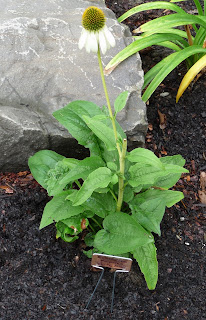
A good rainy day activity: I wrote labels on copper plant markers for many of my plants that didn't have labels. Then got pretty wet going out in the rain to put some in! Well, got some fresh air.
The garden really needed a good watering, so I won't complain, especially since we are due for another dry spell.

The garden really needed a good watering, so I won't complain, especially since we are due for another dry spell.
October 5, 2010
Asclepias physocarpa
I got some unusual plants in July from deGro Flower and Garden Co. They had a booth at the garden I worked at for Federal Way Symphony Garden Tour. They regularly have a table at the Puyallup Farmer's Market. Some of these are zone 8, which is officially my garden. However, they probably won't like to be as wet as we get. With the cold predicted this winter with La Nina, I'm going to dig up more plants than usual to over-winter in the storage room (like a garage).
I already dug up my banana plants and have in four pots. I also potted up the cestrum, and I may keep it in the pot when I bring it out in the spring.
One of my unusual plants is the "hairy balls" plant. It has very interesting seed pods. I took a picture showing them at Kew Gardens in September 2009. Here is that photo as well as a photo of my plant.


I already dug up my banana plants and have in four pots. I also potted up the cestrum, and I may keep it in the pot when I bring it out in the spring.
One of my unusual plants is the "hairy balls" plant. It has very interesting seed pods. I took a picture showing them at Kew Gardens in September 2009. Here is that photo as well as a photo of my plant.


October 1, 2010
Darwin Hybrid Tulip Tulipa 'Apeldoorn'
I saw big bags of these tulips at Lowe's about a week ago. I planted two batches of these three years ago and they have returned better than ever each year. There are only a couple varieties of tulips that return each year. This is one. The species tulips are another type.
For tulips, remember to water if there is a dry spell in the spring. After they finish blooming, they don't want to be watered. I have them along the driveway side of my rose garden. This is a great spot because the roses are watered with drip irrigation, so the happy tulips don't get watered.
The other area I've planted them is along the bed leading up to front door. This area does get irrigation, and they are doing very well. So they must not get too much water.
Here is a photo from last April showing the Apeldoorn tulips. The center is very dark, almost black. I highly recommend planting these - it is nice to get more than one good year for the trouble. Although I admit I planted some other tulips this year with the expectation that I will just get one good year. I planted some in a big pot and others in bed above the upper driveway.
Finally, plant tulips nice and deep - a full 6 inches. Might deter some squirrel feeding, and they will be happier in the long run.

For tulips, remember to water if there is a dry spell in the spring. After they finish blooming, they don't want to be watered. I have them along the driveway side of my rose garden. This is a great spot because the roses are watered with drip irrigation, so the happy tulips don't get watered.
The other area I've planted them is along the bed leading up to front door. This area does get irrigation, and they are doing very well. So they must not get too much water.
Here is a photo from last April showing the Apeldoorn tulips. The center is very dark, almost black. I highly recommend planting these - it is nice to get more than one good year for the trouble. Although I admit I planted some other tulips this year with the expectation that I will just get one good year. I planted some in a big pot and others in bed above the upper driveway.
Finally, plant tulips nice and deep - a full 6 inches. Might deter some squirrel feeding, and they will be happier in the long run.

Subscribe to:
Posts (Atom)
