July 2, 2013

Butterflies! Western Tiger Swallowtail and Mourning Cloak

I got my first pictures of these butterflies in my yard today. I'd seen them before but didn't have my camera. Here are a few of the photos I just took.

The mourning cloak is "puddling" - getting minerals from the mud next to the stream.


June 26, 2013

Staking staking staking!

The heavy rain we've been having was beating down some of my plants. In between rain showers, I've been staking them back up. I needed so many stakes I had to buy more.
The alstroemeria are blooming nicely, but they had quite a pounding from the rain.


I love my potting area / garden shed!

The thing I had that held tools was pretty wobbly, as evidenced by it falling on me and a tool cut my head. So this inspired John to make something to hang tools on the wall. Since the walls are solid cement, he had to drill into the cement to mount the tool rack. Then he helped sort through stuff and dispose of old chemicals and other stuff we don't use. After I did some additional tidying up, I took this photo.
You can see my worm bin on the right. My tool storage rack is along the back wall.

Landscape Design Award

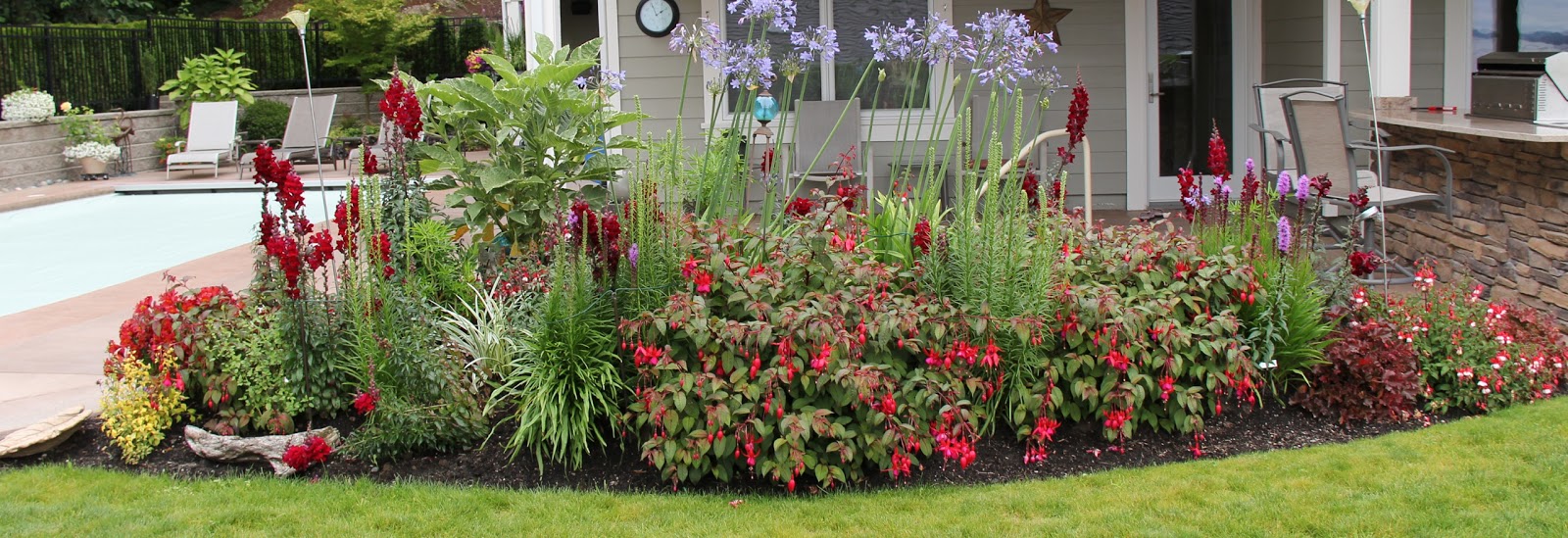
I was awarded the Landscape Design Award by the Washington State Federation of Garden Clubs for my "red, white, and blue" flower bed. This is the bed next to the spa.

The photos and description below are from my application:


The objectives of this garden bed were to have an attractive flower bed to appeal to people sitting nearby on the patio (or in the spa) and to attract hummingbirds and bees (to support pollinators). In addition, we didn’t want plants too tall to block the view or create much shade.
The Choisya ternata ‘Aztec Pearl’ and Heuchera ‘Crimson Curl’ provide evergreen year-round structure, along with the garden art. The fuchsias and agapanthus are attractive well into the fall.
While several of the plants were still small, I filled in with annuals, as shown in the photos. In 2012, I planted white wax begonias along the eastern edge of the bed, and I planted red snapdragons in empty spaces throughout the bed. I also had a pot with a Brugmansia (Angel’s Trumpet) sitting on one of the boulders. The plants have now grown enough so I no longer need to fill in with annuals.

June 25, 2013

Award for "Gardening for Pollinators" Essay

I received a first place for horticulture essay from the Washington State Federation of Garden Clubs for my paper on "Gardening for Pollinators". See the December 6, 2012, blog entry for the content. I also received a 3rd place award for the plant list that goes with the essay.

I gave my Gardening for Pollinators presentation at the Neely Homestead Gardens on June 15, as part of their summer workshop programs.

June 10, 2013

Clematis Jackmani and Jackmanii Superba

These clematis thrive with this southern and western exposure. I usually place pots in front of them to provide a little shade to the lowest section. We've strung nylon rope (not smooth) from the upper deck to give them room to grow higher. Now we can enjoy from both levels!

The Jackmanii has a few open blooms, with many more coming. It blooms a little earlier than the Jackmanii Superba, so we enjoy the blooms for much of the summer.

Jackmanii Superba

Jackmanii

Late Spring Garden

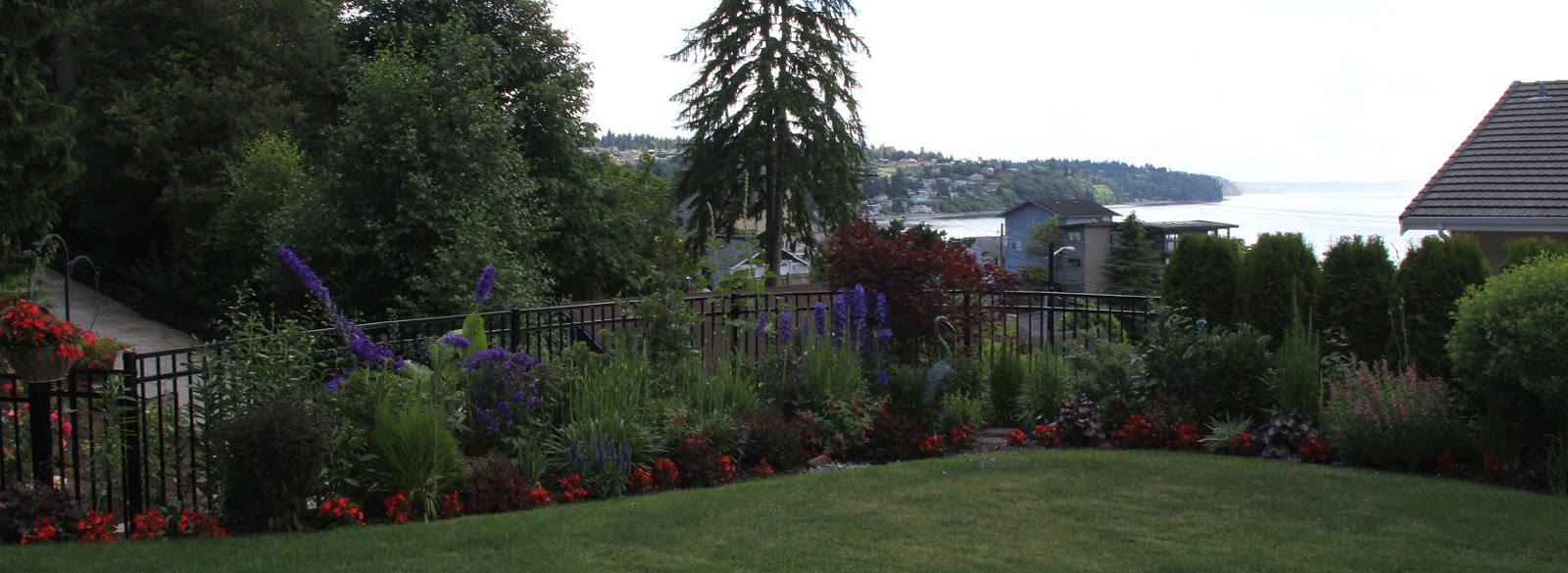
We returned from a trip to England in May 16 to find the garden looking lush and glorious! And it looks better every day. This is such a great time for the garden: It looks beautiful, there is promise of much more in coming months, and there is not much deadheading yet.

We've spent hours in the creek cleaning out weeds and watercress. The birds are so happy to have a nice place for drinks and baths! Can you see the bird in these pictures I took today?


The kalmia (mountain laurel) is covered in blooms, and the Cornus Kousa (dogwood) is in full bloom:

I'm happy with how the upper stream area is coming along. The doublefile viburnum finished blooming vacation, but the hillside is still looking good.


 Rose garden:
 Perennial bed on other side of rose garden. I planted the delphinium last year and am happy to see them return so nicely.
The big garden job now is pulling out crabgrass from the lawn. We've been hand-pulling out the individual weeds. I usually start with the flowering section, then rake through with my fingers to get where each plant is spreading. This leaves the "good grass" in the lawn. We work on it for 30 - 60 minutes at a time. It will be an ongoing process - probably never-ending, but hopefully much less as we go on. Next year, I'll look into an early application of a corn gluten based pre-emergent weed suppressant.

April 29, 2013

The promise of spring

There is a lot to do in the garden in the spring! I've still been busy weeding/hoeing in all areas. I did some pruning of shrubs on the hillside. I removed a lot of the branches that were laying on the ground. They now look tidier, and it will be easier to rake out fallen leaves next winter. I removed several shrubs, as I realized that as they get larger the hillside will be too crowded. I took out several viburnum tinus 'Spring Bouquet' - I had bought and planted too many of these. I have a couple friends who will be able to use them in their yards.
I was able to get several starts from Viburnum plicatun tomentosum 'Mariesii' (doublefile viburnum).I've potted them up and will look after them for this year until they are ready to donate.
Here is a photo of the hillside taken this evening.

My garden club had our plant sale this weekend. Afterwards, I planted annuals in pots - a lot of calibrachoas, one of my favorite annuals. I also planted three flats of scarlet wax begonias (another favorite) between the flower beds and the lawn. Instead of geraniums, I'm trying petunias in the raised beds along the driveway.


 I'm appreciating the varied colors, textures, and shapes of leaves in this bed by my front door. Hosta, ligularia, lace leaf maple, hydrangea, and choisya ternata. (And there are leaves from spent bulbs.)


March 19, 2013

Hoed the entire hillside!

John joined me Saturday for a full morning of hoeing. We got the entire hillside hoed, using our favorite hoe - the action hoe, pictured below. The maple seedlings were so thick that we had to hoe all the surface. It feels so great to get that finished, even though I have a blister.


Since Saturday, I've been going over the rest of the yard to hoe or pick weeds, clean up, and trim as needed.

I also got over to the Foundation House yesterday to prune their rose garden. I replaced four rose bushes, but should add about eight more.

March 15, 2013

Creating some fun garden art

I had fun creating some little water birds from rocks and shells. I selected rocks from the side of my driveway and cleaned them up yesterday. After they were dry this morning, I glued on the heads (from rocks) and beaks (shells).

I placed them along my little stream.

Late winter garden clean-up

I neglected my garden for too much of the winter. I went out occasionally to tidy up my close-in beds, but didn't do anything on the hillside.

I finally got out several times in the last couple weeks and cleaned up debris, trimmed old foliage, and pruned the plants that like late winter pruning. I still have some leaves to rake up and remove from the hillside. The big work ahead is hoeing or pulling thousands of tiny maple trees that sprouted from the little winged things that blew down during the fall and winter. There are so many that I'm quite overwhelmed! I'm sure that once I've spend a couple hours with my hoe and see some progress, I will feel better about the garden chores I am facing.

It does always feel good to come in after getting an area tidied up. Here are photos of some of my cleaned up beds.


Time to prune roses

It is time to prune roses. I pruned my bushes about a week ago, and I will go prune the rose bushes at the Foundation House (where my garden club meets) in a few days.

The first thing I prune is dead or diseased branches. Then I prune out crossing branches and tiny/weak ones. I look at the canes that look healthiest, and prune to an outside bud. The height varies, depending on the location of buds and the individual bush. I also remove all old leaves. I usually remove an old cane, or maybe two. And I cut inward-facing branches and weak branches.

December 6, 2012

Camellia sasanqua ‘Kanjiri’ and Amaryllis

Here is a photo of my Camellia sasanqua 'Kanjiri'. It is blooming on time for Christmas this year. For the winter, I move the pot from its normal sunny spot to the shelter of my front porch. It lost all its flower buds to the bitter cold spell we had over Thanksgiving week in 2010, so I now provide the protection of a covered area next to the house. It is a small tree, as I bought it quite small three years ago.

While I am writing about Christmas plants, I'll include a photo of Amaryllis that are blooming for me now. I staggered the planting of bulbs, so I hope to have blooms over several weeks. Instead of planting in the plastic pot that comes in the package, I pot in a ceramic pot. This gives it more weight to help anchor it and prevent it from falling over (hopefully).

Gardening for Pollinators

Here is the content from an essay I wrote to use as a handout to go with my Gardening for Pollinators presentation.


Each of us can enhance our landscapes while supporting pollinators that are essential to life. We can add habitat and adopt pollinator-friendly landscape practices for bees, hummingbirds, and butterflies. These animals move pollen between flowers to ensure the growth of seeds and fruits. Pollinators are necessary for the reproduction of most of the world’s flowering plants, and about one third of our food crops.
Pollinators are in decline in many areas due to habitat loss, disease, excessive pesticide use, and other factors. The loss of commercial bees to Colony Collapse Disorder (CCD) has received much attention recently, leading to research to understand and mitigate threats to bees. The nonnative European honey bee is the most common domesticated pollinator in the US.
Native bees are our most important pollinators. Nearly 4000 species of bees are native to the US. Honey bees, bumble bees, and some species of sweat bees live in large social groups. Most native bees live as solitary individuals, and they are normally gentle and unlikely to sting. Bees prefer flower colors of white, yellow, blue, and purple (they can’t see red).
Hummingbirds are our primary bird pollinator. Our most common hummingbird, Anna’s Hummingbird, stays in Washington State throughout the year. The Rufous Hummingbird is also common here. Hummingbirds have long beaks and tongues to get nectar from tubular flowers. Their beaks and feathers carry pollen to other plants.
Butterflies also pollinate many plants. To best support butterfly populations, gardens should include host plants for caterpillars, along with nectar plants for butterfly food. Different butterfly species prefer particular plants. Butterflies are guided by scents. They are nearsighted and generally look for bright-colored composite flowers with a landing pad (such as Coneflower, Zinnia, and Aster). Plan an area for butterflies in full sun, with protection from wind, large stones for basking in the sun, and moist soil/mud for needed moisture and minerals.
Support pollinators with these landscaping practices:

  • Provide a variety of plants with diverse flower shapes, colors, and bloom times. Include several plant species that flower each season, forming a sequence of blooms from spring through fall.
  • Emphasize native plants in your garden design. Most pollinators greatly prefer native plants to exotic varieties.
  • Plant flowers in drifts of at least four feet. Masses of single species will attract more pollinators, and allow more efficient pollination, than individual species scattered throughout the garden.
  • Follow Integrated Pest Management (IPM) practices. Target specific pest concerns with the least harmful solution. Learn to live with some damage.
  • Provide a water source with shallow or sloping sides.

Consider that neighboring property may already provide some essential elements to support pollinators. Focus your landscaping efforts on habitat needs missing in the area. Complement existing plants with pollinator-friendly plants, such as those listed.
We each can make a positive impact by providing pollinator-friendly habitats. Let’s all take steps to help pollinator populations thrive.


Gardening for Pollinators - Plant List

I hadn't posted for a couple months, so I am writing several posts today to make up for it!

I put together a presentation for garden club - and other groups - about gardening to support pollinators. Part of the presentation included a handout with plants that I have grown that are good for bees, hummingbirds, and/or butterflies.

Here is the content from the Pollinator Plant List.


Trees and large shrubs – mostly native - for background plants on North or East side of sunny pollinator bed.
Remember that you can ‘borrow’ from adjacent properties, which is useful for large shrubs and trees.

Pseudotsuga menziesii – Douglas Fir
Thuja plicata – Western Red Cedar
Acer circinatum – Vine Maple
Acer palmatum - Japanese Maple
Malus spp. –Crabapple
Omeleria cerasiformis - Indian Plum
Crataegus douglasii – Black Hawthorn
Rhamnus purshiana - Cascara
Lonicera involucrate – Twinberry
Sambucus spp.– Elderberry
Syringa spp. –Lilac
Philadelphus lewisii – Mock Orange
Cornus stolinifera – Red Osier Dogwood
Cornus sericea – Red-twig Dogwood
Cornus alba ‘Elegantissima’ -Variegated red-twig
        dogwood
Ribes sanguineum – Red Flowering Currant
Viburnum tinus ‘Spring Bouquet’
Viburnum plicatum tomentosum ‘Mariesii’
Viburnum trilobum – American Cranberry Bush
Holodiscus discolor – Ocean Spray
Symphoricarpos albus – Snowberry
Ceonothus spp.
Hibiscus syriacus – Rose of Sharon
Lavatera – Rose Mallow

Vines
Lonicera spp. - Honeysuckle
Clematis ssp.

Smaller shrubs
Hebe spp.
Spiraea spp.
Rosa spp.
Rhododendron spp.
Weigela florida ‘Red Prince’& ‘Midnight Wine’
Vaccinium ovatum – Evergreen Huckleberry
Vaccinium - Blueberries
Mahonia spp. – Oregon Grape
Sarcococca ruscifolia (in a shaded area)
Arctostaphylos uva-ursi – Kinnikinnick
Cornus Canadensis – Bunchberry
Heuchera
Iberis spp. - Candytuft


Perennials
Agapanthus africanus
Agastache
Alcea – Hollyhock
Allium
Alstroemeria
Aster spp.
Coreopsis verticillata ‘Zagreb’
Delphinium
Dianthus
Echinacea purpurea – Coneflower
Fuchsia spp.
Gaillardia  spp.
Liatris spp.
Lobelia ‘Queen Victoria’ – Cardinal flower
Lupinus  spp.
Malva – Mallow
Monarda didyma – Bee-balm
Potentilla
Penstemon spp.
Rudbekia – Black-eyed Susan
Salvia microphylla 'Hot Lips'
Sedum telephium 'Autumn Joy'

Annuals
Antirrhinum - Snapdragon
Begonia
Callibrachoa spp.
Canna (red)
Clarkia spp.
Heliotrope
Lantana
Lobularia maritime – Alyssum
Pelargonium – Geranium
Petunia spp.
 Trapaeolum majus – Nasturtium
Zinnia spp.

Pollinator-friendly Landscaping Tips:
·         Select plants with simple flowers (single instead of double).
·         Practice Integrated Pest Management (strive for no pesticide use).
·         Plant in drifts (many of a few varieties is better than many of a few varieties).
·         Emphasize native plants.
·         Include several plant species that flower each season.
·         If you want butterflies, place bird feeders in different areas of your yard.
·         Provide a sunny, sheltered area for butterflies.


References: